Introduction
First Nations peoples have a unique relationship with the environment around them, and thus view the environment with a different frame than is typically embodied by Western society. For this project, we will explore how First Nations peoples relate to the environment around them, particularly how they interact with the ecological process of their land and how that specifically differs from the way in which Western society, and Canada as a whole, relates to the environment and occurring ecological processes. As well, we will also explore how the imposition of Western colonization has impacted First Nations peoples’ interactions with ecological processes, and thus, how Western society has impacted their traditional lifestyles and knowledge.
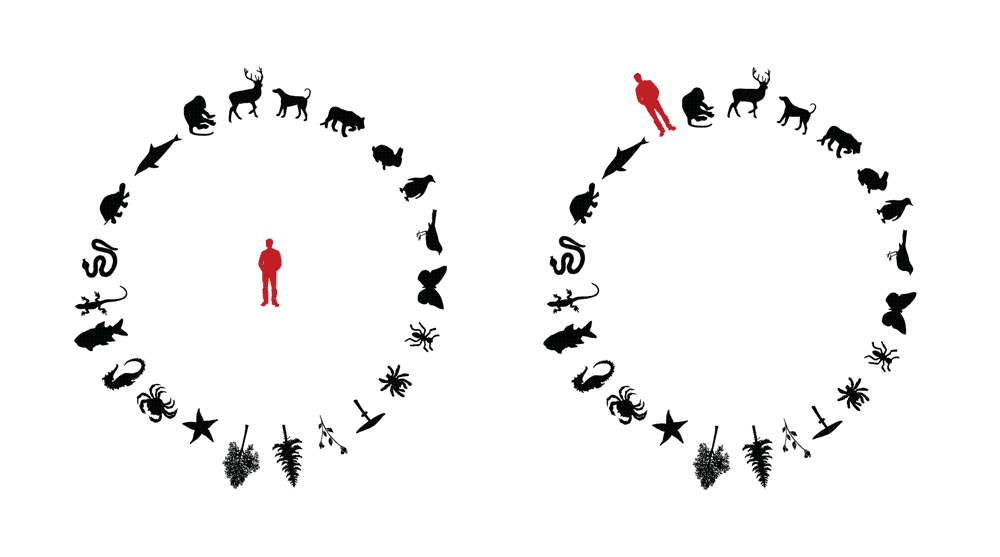
“The European (Western) tradition assumed that humans were meant to be dominant over nature…. Indigenous peoples tended to view themselves not as dominant over, but as connected to and part of, the natural world.”
– Raymond Pierotti
Indigenous peoples inhabited North America far before the intrusion of European explores on the continent. They grew undisturbed for decades–potentially centuries –allowing for the development of hundreds of different cultures across the areas we now define as Canada and the United States. These varying cultures may have differing way of viewing and explaining the world as they experienced it; however, many of these cultures share a base understanding about their connection to the environment around them: people are not above or dominant over the world, but instead are as equally connected to the natural world as every other species and system within that world (Pierotti).
However, Western belief systems dictate the relationship between humans and the natural world differently. Western thought commands that humans are beyond the natural world – that humans may utilize the natural world to fulfill any needs or whims without consideration of the consequences of treating the natural world in such a way (Pierotti).
Cultural Practices
There are more than 600 First Nations communities in Canada (Gadacz et al., 2019). Members of each of these communities have their own unique way of interacting with the natural world around them. Together, these people have maintained the equilibrium of their ecosystems through specific cultural practices and methods of thought, each of which ensured the survival of Canadian biodiversity.
In recent years, this pool of cultural knowledge has been used by classically trained environmental scientists, as researchers begin to realize that indigenous peoples have useful knowledge about sustainable resource use, pest management and conservation that can be beneficial towards combating today’s environmental issues. For example, a group of scientists from Tampere Polytechnic used data about climate change collected by Canadian indigenous groups as part of a multiyear information collection campaign (Houde 2007).
Land Management
In Eastern Ontario and Western Quebec, the Cree people systematically set forest fires to get rid of the undergrowth that can inhibit production. This process helps to improve the forest ecosystem in multiple ways. For example, it helps curb the growth of invasive species and prevent naturally occurring forest fires from spreading uncontrollably. It also creates a variety of micro-ecosystems within a small area, allowing for greater biodiversity and an unrivaled variety of reproductive states for certain species. To the Cree, the burning of undergrowth is not a simply mindless practice, but a way of managing their ecosystems that reflects their symbiotic relationship with the ecosystem and those other species residing within it. The frequency, intensity and type of forest fires is affected by observations of the environment (Johannes 1989).
Similarly, the Cree will only take resources and animals from only one quarter of their land per year, allowing populations to recuperate before they are re-drawn from by the community. There is significant evidence which demonstrates that this selective consumption is a better alternative than both hunting all of one’s territory in one year or not hunting at all when it comes to general ecosystem health. From these examples, it is clear that the Cree are an essential part of the Eastern Canadian natural environment (Berkes, 1988).
Resource Use
Many of Indigenous traditions revolve around the preservation of resources that can be used as food (Feit 1978, Riewe 1988). When Canadian geese populations land in Northern Canada, the Inuit send only one hunter to collect eggs, knowing that this will disturb the nesting birds the least. After a short collection period, the geese are left alone, letting them have a healthy nesting population for future years and demonstrating the Inuit’s respect towards the geese and sustainable resource use (Riewe 1988).
Hunting Traditions
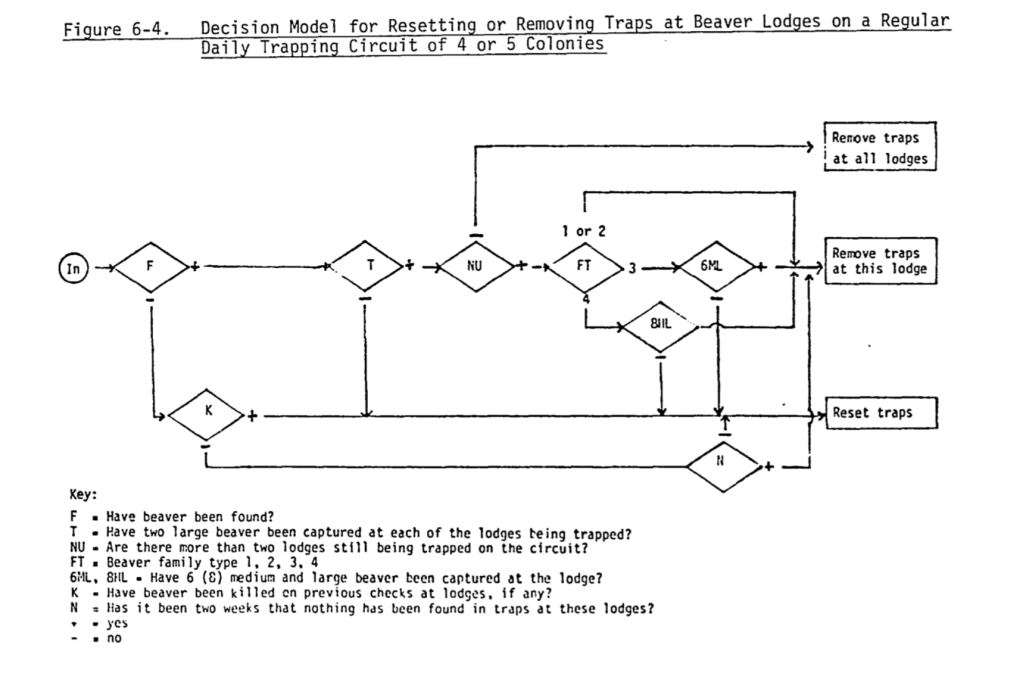
Many First Nations communities also have complex hunting and gathering traditions which help keep populations alive. For example, when hunting beaver, the Wiswinipi people of Ontario take careful note of the ages, genders and number of beaver found along certain routes and use this information to help them decide where to hunt in the upcoming months. If, for example, only one beaver dam is found on a stream, only one beaver is taken. In environments that show evidence of a healthy beaver population, traps are removed after only two large beavers are caught. The full decision tree, which is based on a complex analysis of “family type”, is shown below. The family model is perfected as more and more information about the beavers in an area is found (Feit 1978). Responsibility for specific beaver hunting routes is given to different members of the community. In Quebec, the Cree have split their territory into 400 subsections, each of which is watched over by a specific family. In each section, only the beavers that are needed for food and clothing are killed. To kill an animal for no reason is a heinous offense, also demonstrating sustainable resource practices (Berkes 1998).
Similarly, Cree hunting strategies have been perfected over time and are tied specifically to the animal being hunted. Caribou are only hunted if they are in large herds, not if small groups are spread over a large area. This practice is not observed with any other species (Berkes 1998).
Additionally, the Dene also believe that continuous hunting and trapping in a mindful way helps to ensure healthy populations of prey, an idea which has been confirmed by science. Thus, they let specific habitats rest for a while before returning to hunt again. This practice helps populations return to or surpass their previous levels. To further decrease their effect on the ecosystem, the Dene selectively hunt specific sex and age groups. Females are left alone in the spring and only adults are taken year round (Johnson 1992).
Furthermore, the idea that occasional hunting and trapping can be a good thing is reflected in many other communities, and is often a societal value of specific groups. The Cree believe that part of our duty as humans is to maintain populations in this way. To them, it is well known that animal populations will continue to grow unfettered until the environment can no longer support them. The hunt of animals near this overpopulation point has been shown to help maintain consistent levels of species such as foxes, hare, lynx and otter, many of which do not have other predators. These environmental stewardship practices are associated with societal morals: respect, generosity, reciprocity and care (Berkes 1998).
Historical Perspectives
Colonization and Western Society Affecting First Nations Peoples’ lifestyles
Colonization affects all aspects of Aboriginal peoples’ lives in the nation, community, family and individual levels. Cooperative learning was ignored or seen as inferior and were replaced by industrial and residential schools. And all children were sent to residential schools. The act of establishing residential schools forced all children to abandon their traditional language and lifestyles. The combination of western society and colonization also influenced First Nations Peoples’ food source. Originally, they relied on hunting and fishing to get enough food to feed everyone, however, the restriction towards hunting and fishing forced Indigenous peoples to become farmers. The inadequate farm land and natural phenomena were huge problems for reserve. Severality is introduced; experts were sent to teach Indigenous farmers; and the pass and permit system were established to prevent First Nations Peoples to leave the reserve.
First Nations Peoples interaction with ecology
The interaction between First Nations Peoples and ecology is based on the holistic worldview, which First Nations Peoples thought humans are part of nature, and the environment is part of human. Historically, First Nations Peoples seen them as the steward of our motherland. This perspective influenced how First Nations Peoples interact with their environment and the ecological processes of their land. First, they have extremely high value on protecting their environment and the resources. Their development towards economy and technology is based on the purpose of protecting the nature. Secondly, they believe that every species on earth have their own duty, even though they were hunted or eaten, this is what they meant to be. Finally, they respect every part of nature and they also make sure the interaction with nature brings positive feedback.
Case Study
Ktunaxa Nation v. B.C.[1]
I. Background:
The case arose after the British Columbia Minister of Forests, Land and Natural Resource Operations (the Minister) approved the development of a year-round ski resort within the Jumbo Valley, which makes up part of the traditional territory of the claimant Ktunaxa Nation.
The Ktunaxa Nation sincerely believe that Grizzly Bear Spirit inhabits Qat’muk, a body of sacred land in their religion, and that the Minister’s decision to approve the ski resort would sever their connection to Qat’muk and to Grizzly Bear Spirit. As a result, the Ktunaxa would no longer receive spiritual guidance and assistance from Grizzly Bear Spirit. Their religious beliefs in Grizzly Bear Spirit would become entirely devoid of religious significance, and accordingly, their prayers, ceremonies, and rituals associated with Grizzly Bear Spirit would become nothing more than empty words and hollow gestures. Moreover, without their spiritual connection to Qat’muk and to Grizzly Bear Spirit, the Ktunaxa would be unable to pass on their beliefs and practices to future generations. Therefore, the Minister’s decision approving the proposed development interferes with the Ktunaxa’s ability to act in accordance with their religious beliefs or practices in a manner that is more than trivial or insubstantial.
The Ktunaxa Nation subsequently applied for judicial review, claiming that the Minister’s decision violated their section 2(a) Charter right to freedom of religion and their Aboriginal rights under section 35 of the Constitution Act, 1982.
II. Relevant Law
Supreme Court of Canada says: to establish an infringement of section 2(a) Charter right to freedom of religion, the Ktunaxa Nation must demonstrate
(1) that he or she sincerely believes in a practice or belief that has a nexus with religion, and
(2) that the impugned state conduct interferes, in a manner that is non‑trivial or not insubstantial, with his or her ability to act in accordance with that practice or belief.
III. The Court’s Decision
The Ktunaxa Nation lost in this case. The court’s reasons were as follow.
“In this case, it is undisputed that (1) is satisfied. The Ktunaxa sincerely believe in the existence and importance of Grizzly Bear Spirit. They also believe that permanent development in Qat’muk will drive this spirit from that place.”
“However, The (2) part is not met in this case. This stage of the analysis requires an objective analysis of the interference caused by the impugned state action.The Ktunaxa must show that the Minister’s decision to approve the development interferes either with their freedom to believe in Grizzly Bear Spirit. But the Minister’s decision does not stop the Ktunaxa Nation from believing in Grizzly bear Spirit. This case is not concerned with the freedom to hold a religious belief. The claim is rather concerned with protecting the object of a belief, such as Grizzly Bear Spirit.”
“The state’s duty under s. 2(a) is not to protect the object of beliefs, such as Grizzly Bear Spirit. Rather, the state’s duty is to protect everyone’s freedom to hold such beliefs and to manifest them in worship and practice or by teaching and dissemination. In short, the Charter protects the freedom to worship, but does not protect the spiritual focal point of worship. We have been directed to no authority that supports the proposition that s. 2 (a) protects the latter, rather than individuals’ liberty to hold a belief and to manifest that belief.”
[1] Ktunaxa Nation v British Columbia (Forests, Lands and Natural Resource Operations), [2017] SCJ No 54
Education
Introduction
British Columbia’s grade school system recently underwent a major update. A new curriculum was introduced to the province to modernize the content that is taught to students in primary and secondary school as well as the ways in which a student’s knowledge of this content is assessed. One of the major areas of the curriculum which was redesigned was content related specifically to Aboriginal perspectives and knowledge. The province has stated the following about the redesign of Aboriginal content in the grade school system:
“Aboriginal culture and perspectives have been integrated throughout all areas of learning. For example, place-based learning and emphasis on indigenous ways of knowing reflect the First Peoples Principles of Learning in the curriculum.”
– British Columbia Ministry of Education
(British Columbia a)
The province’s new model for education also has redefined the classes that have been traditionally been known as Biology 11 and Biology 12 to better identify the core concepts of the classes. Currently, the general classes available that cover concepts related to Biology as a sole, individual subject in sciences are named Life Sciences 11, Anatomy and Physiology 12, and Environmental Sciences 12 (which is an amalgamation of concepts relating to a variety of subjects across the sciences and the liberal arts) (British Columbia a).
Each subject area also includes a document outlining the big ideas, curricular content, and the curricular competencies expected for each subject. These documents provide questions that may have important implications for the content of each course, but leaves interpretation of that content as well as teaching methods open for teachers to individualize the curriculum to their preferred classroom environment.
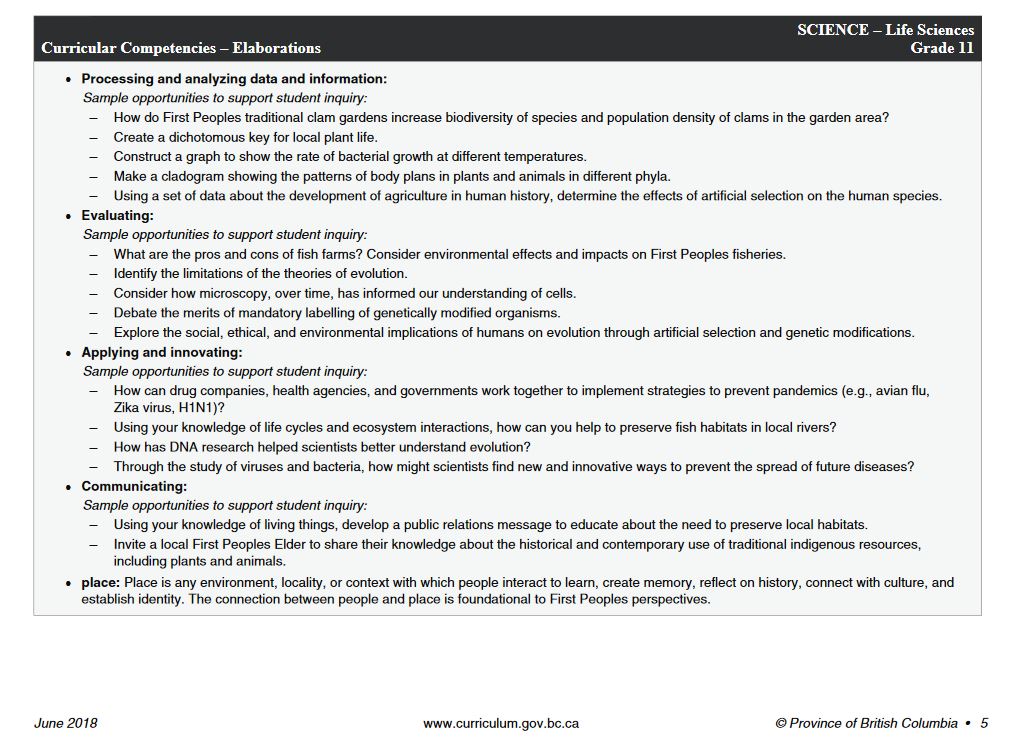
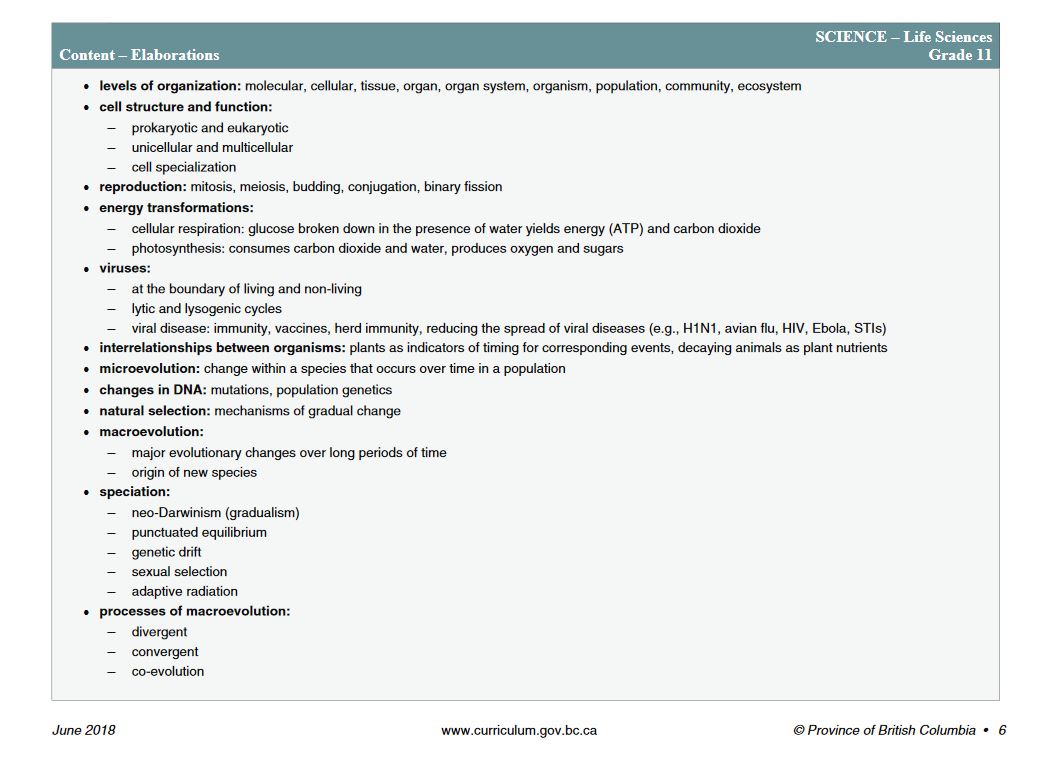
In terms of Indigenous content being included in the curriculum for these biology related classes, these learning standards documents do not mention a great deal about the Indigenous connection to biology in relation to the amount of Western science that is included in these classes. The stated competency regarding Indigenous knowledge in these topics only states the following:
“Apply First Peoples perspectives and knowledge, other ways of knowing, and local knowledge as sources of information.”
-British Columbia Ministry of Education
(British Columbia b)
However, because these curricular documents are so broad and allow for a great deal of interpretation by the educators, a problem arises. Many educators feel uncomfortable with teaching content related to Indigenous knowledge if they themselves are not Indigenous and have not had in depth training in the core ideas of Indigenous Traditional Ecological Knowledge, with the general expression of fear in miscommunication or exemplifying the colonial views that they are seeking to deconstruct through the inclusion of Indigenous knowledge into the curriculum.
Thus, the curriculum guides need to be further expanded to include ideas of how Indigenous knowledge can be more completely and effectively be included within biology related classes at the high school level.
Biological Integration of Indigenous Topics
Every person on this planet lives in the same world. We all live in environments with potentially the same climates, species, issues, etc. However, Indigenous peoples often take these environments and explore them from a very different approach and point of view. This approach is reflected in a number of different learning techniques:
- Learning ultimately reflects the well-being of the self
- Learning ultimately reflects the well-being of the land
- Learning ultimately reflects the well-being of the spirits and the ancestors
- Learning is holistic
- Learning is reflexive
- Learning is reflective
- Learning is experiential
- Learning is relational
- Learning involves recognizing the consequences of one’s actions
- Learning involves generational roles and responsibilities
- Learning involves patience and time
- Learning recognizes the role of Indigenous knowledge
- Learning is embedded in memory, history, and story
- Learning requires exploration of one’s identity
- Learning involves recognizing that some knowledge is sacred and is only shared with permission and/or in certain circumstances
Jo Chrona
To some degree, portions of these learning categories are included in traditional Western education. However, they are often omitted from education in the sciences. In the context of biology in the British Columbia high school curriculum, I will explore ways in which Indigenous forms of learning can be integrated within Western ideas as well as Indigenous contexts.
Life Sciences 11
The grade 11 biology curriculum currently has a focus on the natural side of biology, exploring plants and the natural world and the relationship which humans have with the natural world. In terms of topics related to Indigenous peoples and their relationships with the natural world the BC curriculum has the following:
Curricular competencies: apply First Peoples perspectives and knowledge, other ways of knowing, and local knowledge as sources of information
Content: First Peoples understandings of interrelationships between organisms with a focus on plants as indicators of timing for corresponding events, decaying animals as plant nutrients
– British Columbia Ministry of Education c
These statements do not fully provide current teachers with any methods of teaching these items in such a way that they fully reflect the content as well as the proper teaching methods for that content. In particular the content and the way its taught should reflect the blurring of boundaries between the natural and the social, or the ideas that humans and animals view each other from the same eyes (Pierotti).
To accomplish the breaking down of the Western distinction between humans and animals and the distinction between the environments in which they live, students need to be shown that the world in which they live is the same as all the animals around them, through the inclusion of Indigenous thoughts of education and learning as listed above.
The Medicine Wheel Activity
With the understanding that everything is interconnected on the planet in many Indigenous peoples systems of understanding, that overarching theme also needs to be reflected within the classroom in the context of biology. A good way to introduce this to students initially would be through the idea of the medicine wheel.
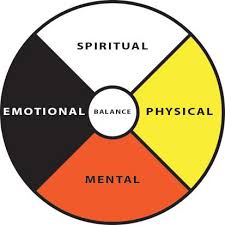
The wheel varies between groups; however, its core concept is the same. It represents an understanding of the connections which exist between everything which exists in the world, they “represent the alignment and continuous interaction of the physical, emotional, mental, and spiritual realities” (Joseph). This concept can apply to all realms of the world, both the internal world of the individual, the external natural world around them, and the connections which exist between those two worlds. To have students in a classroom engage with this idea of interconnectedness in the context of grade 11 biology, each student could receive a print out of the medicine wheel with the overarching topics of each area dictated, as pictured above. They would then take a few minutes to write some ideas of how those areas connect to the natural world which Life Sciences 11 explores. For example, there is some evidence that forests can have a therapeutic effect on people, which could be included as an impact that crosses over the sections of spiritual, emotional, mental, or all three, depending on the student’s own experiences and beliefs. Then, a class-wide discussion in the form of a circle could take place, where each student is allocated the opportunity to talk about the items they chose to incorporate into their wheel.
This type of activity has the potential for incorporating Indigenous topics and learning styles into the overall goal of Western education. For example, by allowing each individual student time to add items to their wheel, their learning becomes reflective as they consider they things important to them in their lives within the context of the medicine wheel, the natural biological world they are considering, and their place in both contexts. In addition, by bringing the entire class together for an overall discussion in the format of the circle, the student is emphasized in learning rather than the teacher, as the circular shape of the discussion does not place any single individual at the top of the hierarchy, but allows for a discussion of views that can focus on the students as equals to the teacher and to each other. It also allows for learning to become relational, as students learn to understand the interconnectedness of their lives and their worlds to each other, through the facilitated group discussion.
The Educational Field Camp
While a more difficult educational experience to integrate into the Western educational format of school, a field camp where students can experience first hand natural biology as well as Indigenous learning goals could fully integrate the topics learned in the classroom more closely to place and people, as Indigenous knowledge typically emphasizes (Chrona). Such a field camp would allow students to take their knowledge to an environment where their learning can become experiential. Ideally, this camp could take place within the traditional territory of the Indigenous peoples where the school is located with an Indigenous elder leading the students in the learning experience. Students could learn traditional methods of plant identification as well as the potential benefits of different plant species within the context of the medicine wheel activity the students would have completed earlier in the school year. As well, the students could learn the traditional language surrounding the environment they would be exploring in the field camp, as language often carries important meaning beyond the actual spoken word and could provide a deeper learning experience. This would allow the students to understand that learning and knowledge can be embedded within history, memory, and story as well as the importance of generational roles, Indigenous traditional knowledge, and the sacredness of certain knowledge within the framework of ecology and Life Sciences 11.
General Incorporation of Indigenous Learning Practices
While the two above activities are focused on traditional Indigenous knowledge in particular, Indigenous learning principles can be applied to what Western education as well in order to make the BC education experience more holistic and student oriented. For example, Jo Chrona – on her educators blog – recognizes the importance of student-oriented learning within Indigenous traditions. In particular, education should be altered to fit the student rather than have the student alter themselves to fit the strict, inflexible education system. Particularly, many science classes at the high school level focus on the rote memorization of information through the format of many smaller tests and a final exam at the end of the school year. However, not every student learns best through memorization and test taking, and it would be more aligned with Indigenous principles of learning to have some kind of final project whereby the students are able to control their topics and final outcome of the project, with some guidance from the teacher to help students develop skills to create a project in-line with class objectives. This provides the opportunity to bring a more holistic experience into the science classroom, and may also be a good way to incorporate Indigenous learning principles into younger classes (such as Science 8, 9, or 10) where every student is required to take science within the same format. Similarly, to include the idea of consequences of one’s actions into course material, climate change should also be included as a topic, especially in consideration of who are predicted to be the most impacted by climate change (often including Indigenous peoples) and why Indigenous peoples may be most impacted based on ecological and historical considerations and knowledge.
Anatomy and Physiology 12
The grade 12 level of biology approaches Indigenous topics from a similar broad view as Life Sciences 11, but without providing any suggestions for content to be included in the curriculum. Anatomy and Physiology 12 has a focus less on the natural environment on the planet and more on the human aspect in regards to health and the human body (British Columbia d).
However, Indigenous knowledge revolves around the idea that everything in the world is interconnected. Thus, the human body and its health is not separate from the topics learned in Life Sciences 11. Thus, many of the same activities can also be used in the grade 12 level of biology to continue the integration of Indigenous learning principles in B.C’s Western education system.
The Medicine Wheel Activity
The medicine wheel activity could also be utilized in much the same manner as in Life Sciences 11. However, as knowledge in sciences to build on itself over time, at the senior level, many students would have more knowledge and experience that they could integrate into the medical wheel while still remaining within a body and health frame. The base activity would still remain roughly the same in order to still integrate the Indigenous learning principles identified in the grade 11 medicine wheel activity.
Learning from an Elder
Generational knowledge from Indigenous elders can also still be incorporated into the curriculum of Anatomy and Physiology 12, particularly in terms of spiritual knowledge of the human body, the human body’s interconnectedness with the natural world, and traditional medicinal techniques. The elder would preferably be given control of the learning experience of the class and could teach the class through traditional techniques, highlighting the learning principles related to generational knowledge, well-being (of the self, land, and the spirits and ancestors), the role of Indigenous traditional knowledge, and the embedding of knowledge in history, memory, and story. In addition, a plant walk could also occur, whereby students reprise the same techniques learned in Life Sciences 11 to identify plants and their medicinal values and potential harmful effects. In B.C., Life Sciences 11 is not the only pre-requisite for taking Anatomy and Physiology 12 and therefore, students may enter the class without previously have completing the Life Sciences 11 educational field camp. Thus, it is important that every student have the opportunity to learn about the world around them from an Indigenous perspective and within the natural world to still employ Indigenous learning principles.
General Incorporation of Indigenous Learning Principles
The consequences of one’s actions also is relevant in terms of human anatomy and physiology. In particular, climate change – as well as general human kind pollution of the planet – is known to have particular health effects on human populations. Exploring these health effects from the principle of well-being (of the self, land, and spirits) would allow students to identify how previous generations of humans are still impacting humans today and the long lasting impacts of the actions of people on health. In addition, tackling the idea of health from a more holistic approach by including a discussion on current health care and how it can be improved by initiating Indigenous health practices into health care (particularly health care that be more fully symbolized via a representation such as the medicine wheel). This would allow students to more fully engage with the Western societal ideals and practices that are often encountered, bring the community into the classroom and presenting students with a reflective experience.
Resources for Educators
This section provides a list of a few potential resources that current high school science educators can use to bring more Indigenous topics and principles of learning into the science environment, which is often a daunting task.
First Peoples Principles of Learning
Jo Chrona is a high school educator of over 20 years who had a role in shaping the way Indigenous topics are being approached in B.C’s current curriculum with the new change in curriculum. She provides a blog that speaks to all 9 of the Indigenous principles of learning, and suggests methods for integration of each principle within the classroom. Her suggestions are not topic or class specific, but provide educators with a base for integrating Indigenous learning principles in their classroom.#342aff
B.C.’s New Curriculum: Indigenous Education Resources
With the new change in the B.C. high school curriculum, more Indigenous topics were included within class curriculum documents. However, those documents do not provide much guidance on the best methods for including Indigenous topics and learning techniques within the classroom, which is often an area that educators can be uncomfortable approaching because of that lack of guidance as well as a lack of overall knowledge. The B.C. government provides this webpage that includes resources for educators to access to help educators further incorporate Indigenous knowledge and perspectives into their classrooms.
Aboriginal Education Teaching Tools and Resources
This is the old page that existed prior to the creation of the new curriculum a few years ago for teachers to access. While it is a little outdated in terms of content and vocabulary, it does still have useful links to information on other pages and documents that may act as a good starting point for educators.
How colonization and western society affect First Nations Peoples’ lifestyles?
The First Peoples has their own economic, political, and social systems that within their communities. However, colonization affects all aspects of the first nation peoples. Colonization has deleterious effects on to the Indigenous way of life as it destroyed their political system and desecrated their religious beliefs.
The First Nations Peoples’ connection to the land has its own unique primitiveness. Cultural oppression, when coupled with colonial action, was especially embodied in the establishment of residential schools.
All First Nations children were removed, sometimes forcefully, from their homes, families, culture, and language at a very young age. Residential schools serves as a form of cultural assimilation, by forcing first nation children abandon their native language.
Colonization also influenced First Nations Peoples’ livelihood. Originally, they relied on hunting and fishing. European Colonizers imposed restriction on indigenous activities by making first nation peoples adopt new farming technologies. Thus, the colonizers deprived them of their lands and exploit their labour force.
First Nations Peoples have alway seen themselves as the steward of their motherland. This perspective influenced they interact with the environment. In indigenous communities, respect for land and nature is heavily celebrated. They also believe that all beings are equal, hence any forms of social hierarchy doesn’t exist.
(A video to o learn more about the Blackfoot Confederacy, one of the most legendary tribes of the North American plains)
(The Globe and Mail’s Sherrill Sutherland takes a look at the disconcerting gap in education, wealth and health between First Nations people and the rest of Canada)
(Indigenous Hunter Keeps Traditions Alive in Boreal Forest)
( Lutsel K’e Dene First Nation, a remote Indigenous community on the east arm of Great Slave Lake in Canada’s boreal forest. Their lifestyles are experiencing some changes, and so is the forest landscape, as demand for the area’s rich natural resources expands.)
References
British Columbia a. “B.C.’s New Curriculum: Science.” Retrieved from https://curriculum.gov.bc.ca/curriculum/science.
British Columbia b. “Life Sciences Learning Standards.” Retrieved from https://curriculum.gov.bc.ca/sites/curriculum.gov.bc.ca/files/curriculum/science/en_science_11_life-sciences_elab.pdf.
British Columbia c. “Life Sciences 11.” Retrieved from https://curriculum.gov.bc.ca/curriculum/science/11/life-sciences.
British Columbia d. “Anatomy and Physiology 12.” Retrieved from https://curriculum.gov.bc.ca/curriculum/science/12/anatomy-and-physiology.
Chrona, Jo. “First Peoples Principles of Learning.” Retrieved from https://firstpeoplesprinciplesoflearning.wordpress.com/.
Joseph, Bob. “What is an Aboriginal Medicine Wheel?” Indigenous Corporate Training Inc., 2013, Retrieved from https://www.ictinc.ca/blog/what-is-an-aboriginal-medicine-wheel.
Pierotti, R. (2010). Indigenous Knowledge, Ecology, and Evolutionary Biology. New York: Routledge. ISBN: 9780203847114.
[1] Ktunaxa Nation v British Columbia (Forests, Lands and Natural Resource Operations), [2017] SCJ No 54
Joseph, B. (n.d.). Indigenous Peoples and the Environment. Retrieved from https://www.ictinc.ca/blog/indigenous-peoples-and-the-environment.
Gregory, & M., D. (1970, January 1). Cultural Competence and Cultural Safety in First Nations, Inuit and Métis Nursing Education: An Integrated Review of the Literature. Retrieved from https://hdl.handle.net/10133/720.
Hart-Wasekeesikaw, F. (2009). Cultural Competence and Cultural Safety in First Nations, Inuit and Métis Nursing Education: An Integrated Review of the Literature. Ottawa: Aboriginal Nurses Association of Canada.
 First Nations Peoples and Lifestyles